The science, honestly weighed
Potential advantages
- The targeting really is selective: melanin in the hair absorbs the light far more strongly than the skin around it, which is what allows a follicle to be damaged without an open wound
- Pooled trial data put hair reduction between 27 and 84.3 per cent depending on the platform, and longer wavelengths have extended safe treatment to Fitzpatrick I to VI skin including tanned skin
- It covers ground far faster than electrolysis: in one comparison of 52 patients, laser needed 8.1 sessions of 26 minutes against 24.3 sessions of 152 minutes
Limitations and trade-offs
- The cleared claim is reduction, not removal. Trials and clearances stop at 12 months, so there is no controlled data on what happens after that and maintenance is a realistic expectation
- The physics needs a pigmented target, so white, grey, red and fine vellus hair are effectively untreatable, and a randomised attempt to add artificial pigment managed 14 per cent reduction against 10 per cent in controls
- Real courses run longer than the headline numbers suggest: 150 patients with Fitzpatrick IV to VI skin averaged 8.9 treatments for 54.3 per cent reduction
Every clinic website says the same thing: the laser targets the hair follicle. It is true, and it explains almost nothing. Light does not know what a follicle is. What actually happens rests on a single idea published in 1983, and once you have that idea the rest follows: why it takes a course rather than an appointment, why it works beautifully on dark hair and not at all on grey, why the honest claim is permanent reduction rather than removal, and why a practitioner who quietly turns the energy down to keep you comfortable may not be doing you a favour.
The one idea behind every hair removal laser
The principle is called selective photothermolysis, and it was set out by R. Rox Anderson and John Parrish in Science in 1983. The word is really a recipe. Selective: one structure and not its neighbours. Photo: light. Thermo: heat. Lysis: destruction. Deliver light that your target absorbs far more strongly than the tissue around it, in a burst short enough that the heat stays where it lands, and you can wreck that target while everything a fraction of a millimetre away survives.
In laser hair removal the absorbing target, the chromophore, is melanin: the pigment that gives hair its colour, concentrated in the shaft and in the follicular epithelium wrapped around it. The hair behaves like an aerial. It collects the light, turns it into heat, and conducts it down to the structures at the base of the follicle that would otherwise regrow it.
Three settings decide whether that happens.
Wavelength: reaching the target without cooking the skin
Melanin absorbs most greedily at the blue and green end of the spectrum, but so does much else in skin, and short wavelengths do not travel far. A follicle sits between 2 and 7 mm below the surface, and a growing hair extends 2 to 5 mm into the dermis. Only wavelengths between 630 and 1100 nm reach its whole length, and everything on a clinic’s device list lives inside that window.
| Platform | Wavelength | Who it suits |
|---|---|---|
| Ruby | 694.3 nm | Fitzpatrick I to III; manufacturers advise against IV to VI |
| Alexandrite | 755 nm | Fitzpatrick I to III, with extreme caution in IV to VI |
| Diode | 805 to 810 nm, 940 to 980 nm, 1060 nm | 805 and 1060 nm handpieces are cleared for Fitzpatrick I to VI including tanned skin |
| Nd:YAG | 1064 nm | Described by manufacturers as most suitable for Fitzpatrick IV to VI |
| IPL, a filtered flashlamp rather than a laser | 400 to 1400 nm | Broadband and non-coherent, so less energy sits at the ideal absorption wavelength |
Longer wavelengths travel deeper and are absorbed less by the melanin in your own epidermis. That is why 1064 nm is the safer choice on darker skin, where the epidermis is itself a competing target, and why the earliest ruby and alexandrite machines were confined to pale skin with dark hair.
Pulse duration: the timing trick that protects your skin
This is the genuinely clever part, and where most of the safety comes from. Every structure in skin has a thermal relaxation time: the time it needs to shed half the heat a pulse has put into it. Small structures shed heat quickly. Larger ones hold on to it.
| Structure | Time to shed half the heat |
|---|---|
| Epidermis | 3 to 10 ms |
| Hair follicle | 40 to 100 ms |
That gap is the whole game. Fire a pulse longer than the epidermis needs to cool but shorter than the follicle needs, and the surface offloads heat as fast as it arrives while the follicle bakes. Calibre shifts the setting again: fine hair heats quickly but cannot hold heat, so it wants pulses of roughly 5 to 10 ms, while thick hair wants 40 to 60 ms.
Fluence: enough energy, and not much more
Fluence is the energy delivered per square centimetre. Efficiency rises with it, and so does risk: too much heat burns, while too little produces only temporary hair loss lasting one to three months. Published parameter sets cluster around 20 to 30 J/cm².
Under-dosing is not the cautious option it sounds like. A retrospective study of 329 patients treated with a long-pulsed alexandrite laser found that 17 of them, 5.2 per cent, developed paradoxical hypertrichosis: more hair rather than less, all on the face and neck. Their mean fluence was 15 J/cm², and the authors concluded that darker skin types and suboptimal fluences look like risk factors. A gentle setting is not automatically a safe one.
Cooling is what makes those energies bearable
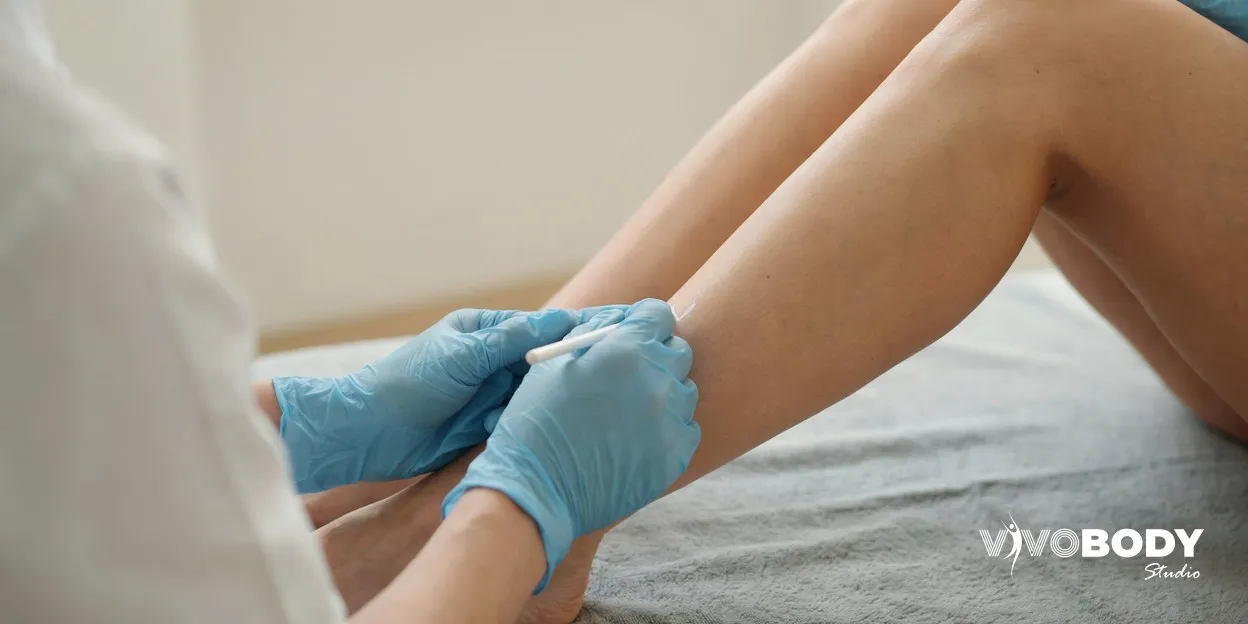
Numbers like that would be intolerable without cooling the surface, either with a burst of cryogen sprayed milliseconds before the pulse or a chilled sapphire window held in contact with the skin. Cooling is what allows a fluence high enough to reach the follicle rather than one merely high enough to make you flinch.
Eye protection is the other non-negotiable. The American Society for Laser Medicine and Surgery warns that a laser beam directed toward the eye may easily penetrate the eyelid or the cornea, and names eyewear as the most important preventable risk factor. The Health and Safety Executive warns that high-power lasers can cause serious damage to the eye, including blindness. Everyone in the room wears goggles, you included.
Why one session can never be enough
This is where the physics collides with biology. Hair grows in four phases: anagen (growth), catagen (regression), telogen (rest) and exogen (shedding), and follicles cycle independently rather than in step. Only anagen hairs are reliable targets, because that is when the hair is thickest, most pigmented and still connected to the structures a laser needs to damage. A follicle in telogen is effectively invisible to the light.
So each session treats only the hairs growing that week, and that fraction depends on the area. Around 9 per cent of scalp hair is in telogen at any moment, against 40 to 50 per cent on the trunk, and facial hair runs 50 to 65 per cent anagen, each growth phase lasting 3 to 4 weeks.
Nobody has published site-specific anagen percentages for the underarm, bikini line or legs, so the 4 to 6 week interval the American Academy of Dermatology suggests is a sensible clinical convention rather than a figure measured at those sites.

Where the physics simply runs out
No pigment means no chromophore, and nothing for the light to grab hold of. Lasers are ineffective for thin vellus hairs, and white, grey, or red hairs. No clinic can train its way around that.
Researchers have tried supplying the pigment artificially. A randomised trial applied a liposomal melanin spray before an 800 nm diode laser across 42 areas in 16 patients and reached 14 per cent reduction at six months against 10 per cent in controls, an outcome its own authors called disappointing. If your hair is grey, white or genuinely blonde, the honest answer is that laser is not the right treatment for you.
Reduction, not removal, and why the physics says so
The mechanism explains the wording on every clearance letter. Devices are cleared for permanent hair reduction, which the FDA defines as the long-term, stable reduction in the number of hairs regrowing when measured at 6, 9, and 12 months after a course finishes. The same regulator reserves the phrase permanent hair removal for electrolysis, not laser. That gap is not pedantry: it describes a follicle damaged rather than destroyed. A 2025 study proposes that laser exposure also injures bulge stem cells and can push follicles into a prolonged empty resting state, which would account for both durable reduction and late regrowth.
The numbers behave accordingly. A 2022 systematic review put hair reduction at 30 to 73.6 per cent for Nd:YAG, 35 to 84.3 per cent for alexandrite, 32.5 to 69.2 per cent for diode and 27 to 52.7 per cent for IPL, and 150 patients with Fitzpatrick IV to VI skin averaged 8.9 treatments for 54.3 per cent reduction. UK clinics commonly quote 6 to 8 sessions at published prices of roughly £35 to £300 each. Most patients see some regrowth, and maintenance is normal rather than a failure, which is why the difference between reduction and removal is worth understanding before you pay for a course.
Be wary of the word cleared, too. It means only that a device is substantially equivalent to one already sold: the FDA does not assess or compare clinical efficacy or efficiency, and its decisions carry no legal standing in the UK.
What this means for choosing a clinic in Glasgow
The physics is universal. Who checks that it is applied properly is not, and here Scotland is genuinely further ahead than England.
Independent healthcare services in Scotland must register with Healthcare Improvement Scotland, and running an unregistered one is an offence under section 10Z9 of the National Health Service (Scotland) Act 1978. Laser and IPL have sat under that oversight since 1 April 2016. In England, a clinic offering laser or IPL for purely cosmetic purposes does not have to register with the Care Quality Commission and licensing is left to individual councils, so if you have read a national article telling you to check a clinic’s CQC registration, that advice was not written for you. Scotland has gone further still: the Civic Government (Scotland) Act 1982 (Licensing of Non-surgical Procedures) Order 2026 brings a named list of procedures into licensing, non-ablative laser and light among them.
None of that tells you whether the person treating you has picked the right wavelength for your skin. Four questions do most of that work: which wavelength and why, what fluence and pulse duration, did you patch test, and who is your Laser Protection Adviser. A clinic that answers all four without hesitating is telling you something real about its standards.
Selective photothermolysis is an elegant piece of physics and it does what it claims. What it does not do is remove hair permanently, work on hair without pigment, or excuse anyone from tuning the settings to the person in front of them. If you want a straight answer about whether laser hair removal will do anything useful for your hair colour and skin tone, our practitioners at our Glasgow clinic will tell you at a consultation, including when the answer is that the physics is not on your side.
Frequently asked questions
Questions about laser hair removal.
What is selective photothermolysis in plain English?
It is the principle that you can destroy one structure in the skin without harming its neighbours, provided three things line up. The light has to be a wavelength your target absorbs much more strongly than the surrounding tissue, the energy has to be high enough to damage it, and the pulse has to be short enough that the heat stays in the target rather than spreading out of it. In hair removal the target is the melanin in the hair, which absorbs the light and conducts the heat down into the follicle.
Why do I need so many sessions?
Because only hairs in their active growth phase are reliable targets, and your follicles cycle independently rather than in step. Each session catches whatever fraction happens to be growing that week. The American Academy of Dermatology suggests treatments every 4 to 6 weeks and says most patients need 2 to 6 of them, though real courses often run longer. In one study of 150 patients with Fitzpatrick IV to VI skin, the average was 8.9 treatments for 54.3 per cent reduction.
Does laser hair removal work on grey, white or blonde hair?
No, and no clinic can get around it. The treatment needs melanin in the hair to absorb the light, and non-pigmented hair has none. Research that tried to supply the pigment artificially, using a liposomal melanin spray before an 800 nm diode laser, achieved 14 per cent reduction against 10 per cent in controls, an outcome its own authors described as disappointing. Fine vellus hair is equally difficult for the same reason.
Is laser hair removal permanent?
Devices are cleared for permanent hair reduction, not permanent hair removal, and the difference matters. The FDA defines that reduction as a long-term, stable drop in the number of hairs regrowing, measured at 6, 9 and 12 months after a course finishes. There is no controlled durability data beyond 12 months at all. Most patients see some regrowth, usually finer and lighter than before, and maintenance sessions are a normal expectation rather than a sign that something went wrong.
Who regulates laser hair removal clinics in Scotland?
Healthcare Improvement Scotland. Independent healthcare services in Scotland must register with it, and providing an unregistered independent healthcare service is an offence under section 10Z9 of the National Health Service (Scotland) Act 1978. Laser and IPL have sat under that oversight since 1 April 2016. The Care Quality Commission, which national articles routinely tell readers to check, regulates England only and has no role here.